There is a small irony in the shower: the loofah you use to get clean can, if you neglect it, end up dirtier than almost anything else in your bathroom. Left damp and full of dead skin, a loofah becomes a warm, wet home for bacteria and mould, and research has found they can harbour a startling amount of it after only a few uses.
Here is the reassuring part, and the whole point of this guide: the loofah was never really the problem. Neglect is. A loofah that is rinsed after every use, dried properly, deep-cleaned once a week and replaced on schedule stays perfectly hygienic. Do those four things and you never have to think about it again.
The 15-second version: rinse your loofah after every use, hang it to dry somewhere airy (not in the shower), deep-clean it once a week, and replace a natural loofah every 3 to 4 weeks. That is the entire routine.
Why a loofah needs cleaning at all
A loofah does two things that bacteria love: it stays wet, and it collects the dead skin cells and soap residue you scrub off. Sitting in a humid shower, it rarely dries out fully between uses, and that damp, nutrient-rich environment lets bacteria, mould and mildew multiply. Widely-cited research has found loofahs can hold millions of bacteria, which is where their bad reputation comes from.
There is one situation worth taking seriously: using a grimy loofah on freshly shaved skin. Shaving leaves tiny nicks, and a bacteria-laden loofah can push those bacteria straight into them, which can cause irritation or a minor skin infection. It is the main reason some dermatologists are cautious about loofahs at all. But it is entirely avoidable with basic care, so let's get into it.
How to clean a loofah, step by step
1. Rinse it after every single use
As soon as you're done, rinse the loofah under warm running water until all the soap suds are gone. Leftover soap residue is sticky and traps skin cells, giving bacteria something to feed on, so a thorough rinse is the simplest and most important daily habit.
2. Dry it properly (this is the step everyone skips)
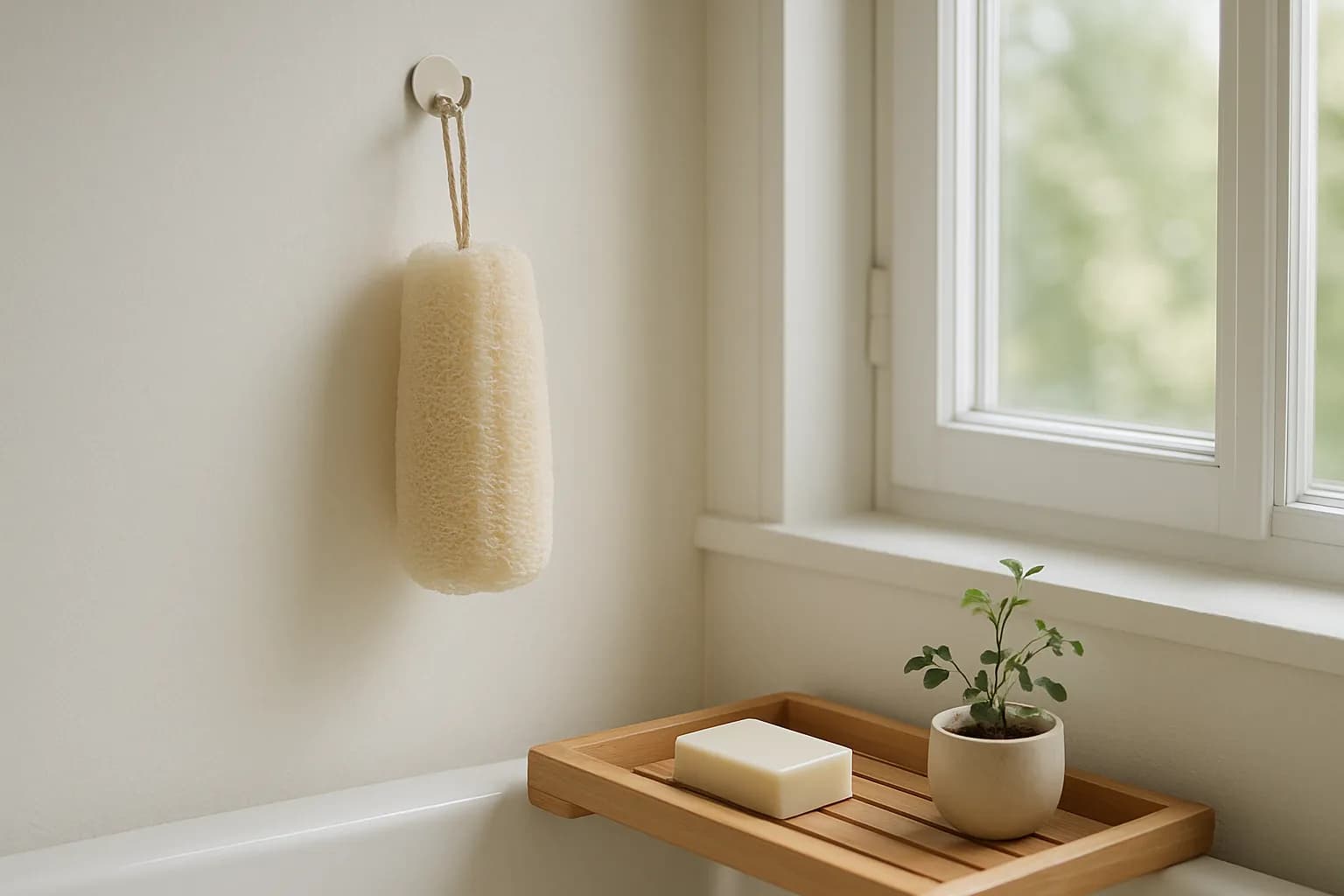
Moisture is the enemy, so drying matters more than any fancy disinfectant. Squeeze out the excess water and hang the loofah somewhere with real airflow so it dries completely before its next use. Crucially, do not leave it in the shower — that humid corner keeps it permanently damp. Hang it on a hook outside the cubicle, by an open window, or anywhere it can actually dry out.
3. Deep-clean it once a week
Daily rinsing can't reach everything, so once a week give your loofah a proper disinfecting soak. You have several options, and for a natural plant fibre we'd reach for the gentler, greener ones first:
| Method | How to do it | Notes |
|---|---|---|
| White vinegar | Soak in 1 part vinegar to 2 parts warm water for 10–15 minutes | Gentle on natural fibres, deodorises, eco-friendly. Our default pick. |
| Hydrogen peroxide (3%) | Soak for about 10 minutes | Excellent disinfectant that breaks down into just water and oxygen |
| Boiling water | Immerse for 5–10 minutes | Chemical-free; nothing but water and heat |
| Diluted bleach | Soak 5 minutes in a mild solution (about 1 tbsp bleach per litre of water) | The most powerful option, but the harshest — see the note below |
Whichever you choose, rinse the loofah thoroughly afterwards until any smell is gone, then hang it to dry completely before using it again.
On bleach: you'll see it recommended everywhere, and dermatologists do rate it as the most effective disinfectant. It works — but for a natural plant fibre we prefer vinegar, peroxide or boiling water. They disinfect beautifully, they're gentler on the luffa and your skin, and they're kinder to the planet, which is presumably why you chose a natural loofah in the first place. Save bleach for a loofah that's genuinely mouldy, use it in a ventilated room, and never soak longer than 5 minutes or mix it with other cleaners.
A quick word on the microwave trick: microwaving a damp loofah for 30 seconds does kill germs, but only if it is thoroughly soaking wet. A dry or half-dry loofah can scorch or even catch fire, so we'd skip it. A vinegar soak gives you the same peace of mind without the risk.
How often should you replace a loofah?
Even with perfect care, a loofah is a wear item, not a forever tool. Dermatologists broadly agree on the timing:
- Natural loofahs: every 3 to 4 weeks.
- Plastic poufs: every 2 months.
Replace it sooner the moment you notice any of these warning signs:
- A musty, sour or mildewy smell
- Dark spots or visible mould (black or green)
- A slimy, mushy or breaking-down texture
- Any discolouration that won't rinse out
This is where a natural loofah quietly wins. Because a real luffa is plant-based, inexpensive and home-compostable, replacing it every few weeks is genuinely guilt-free: the old one goes on the compost heap, not in the bin, and it costs pennies to swap. A plastic pouf, by contrast, is landfill every couple of months, forever.
Natural vs. plastic loofah: the eco case
It's worth being clear that the fluffy plastic "loofah" pouf and a real loofah are completely different things. One is a synthetic-mesh product; the other is the fibrous inside of a luffa gourd, an actual plant.
The plastic pouf sheds microplastics every time you use it, can't be recycled, and lingers as pollution for centuries. A natural loofah is grown, not manufactured, exfoliates just as well, and composts cleanly at the end of its short life. If you're cleaning your loofah anyway, a natural one rewards that care by being the far better choice for your skin and the planet. For more low-waste bathroom ideas, see our zero-waste home guides and the Ecoxee shop.
Loofah hygiene: a few do's and don'ts
- Don't use it on your face. A body loofah is too abrasive for delicate facial skin — use a gentle cloth or a soft konjac sponge instead.
- Don't use it right after shaving. Give freshly shaved skin a rest to avoid pushing any bacteria into tiny nicks.
- Don't share a loofah. Like a toothbrush, it's a personal item — sharing means swapping skin cells.
- Do give it a home outside the shower. A hook by an open window does more for hygiene than any weekly soak.
Frequently asked questions
Are loofahs unhygienic? Only if neglected. A loofah that's rinsed, dried properly, deep-cleaned weekly and replaced on time stays perfectly clean. The horror stories come from loofahs left permanently damp in the shower and used for months on end.
Can you put a loofah in the washing machine? A synthetic pouf can usually go in a laundry bag on a warm wash. A natural loofah is better cleaned by soaking (vinegar, peroxide or boiling water) — the machine's agitation can break down the plant fibres faster.
How do I know when to throw my loofah out? Bin (or compost) it the moment it smells musty, feels slimy, discolours, or shows any mould — and in any case every 3 to 4 weeks for a natural one.
Is a washcloth more hygienic than a loofah? It can be, because it dries fast and you can machine-wash it after every use. If you have very sensitive skin or shave often, a washcloth is a fair, low-fuss alternative — but a well-cared-for natural loofah is perfectly hygienic too.
The bottom line
Cleaning a loofah takes about five minutes a week: rinse it after every use, dry it somewhere airy, give it a weekly vinegar or peroxide soak, and replace a natural one every 3 to 4 weeks. Do that, choose a compostable natural luffa over a plastic pouf, and you get gentle exfoliation, a genuinely hygienic tool, and zero plastic waste — all at once.
Ecoxee is an Amazon Associate and may earn from qualifying purchases through these links. Learn more.

ALMOONI Natural Egyptian Loofah (3-count)
Three real Egyptian loofah sponges, the fibrous inside of a luffa gourd, for plastic-free exfoliating in the shower. A genuine, compostable swap for the synthetic pouf.
Read our full review →
Skoy Reusable Dish Scrubbers (4-pack)
Flat, quick-drying cellulose-and-cotton scrubbers that replace disposable sponges: non-scratch, dishwasher-safe, and compostable at the end of their long life.
Read our full review →For more simple swaps, browse our zero-waste home guides or the full Ecoxee shop.
Keep reading: What Is Toilet Paper Made Of?, Zero-Waste Cleaning Products: A Plastic-Free Kit, and Zero-Waste Deodorant: Bars, Jars & Refills.