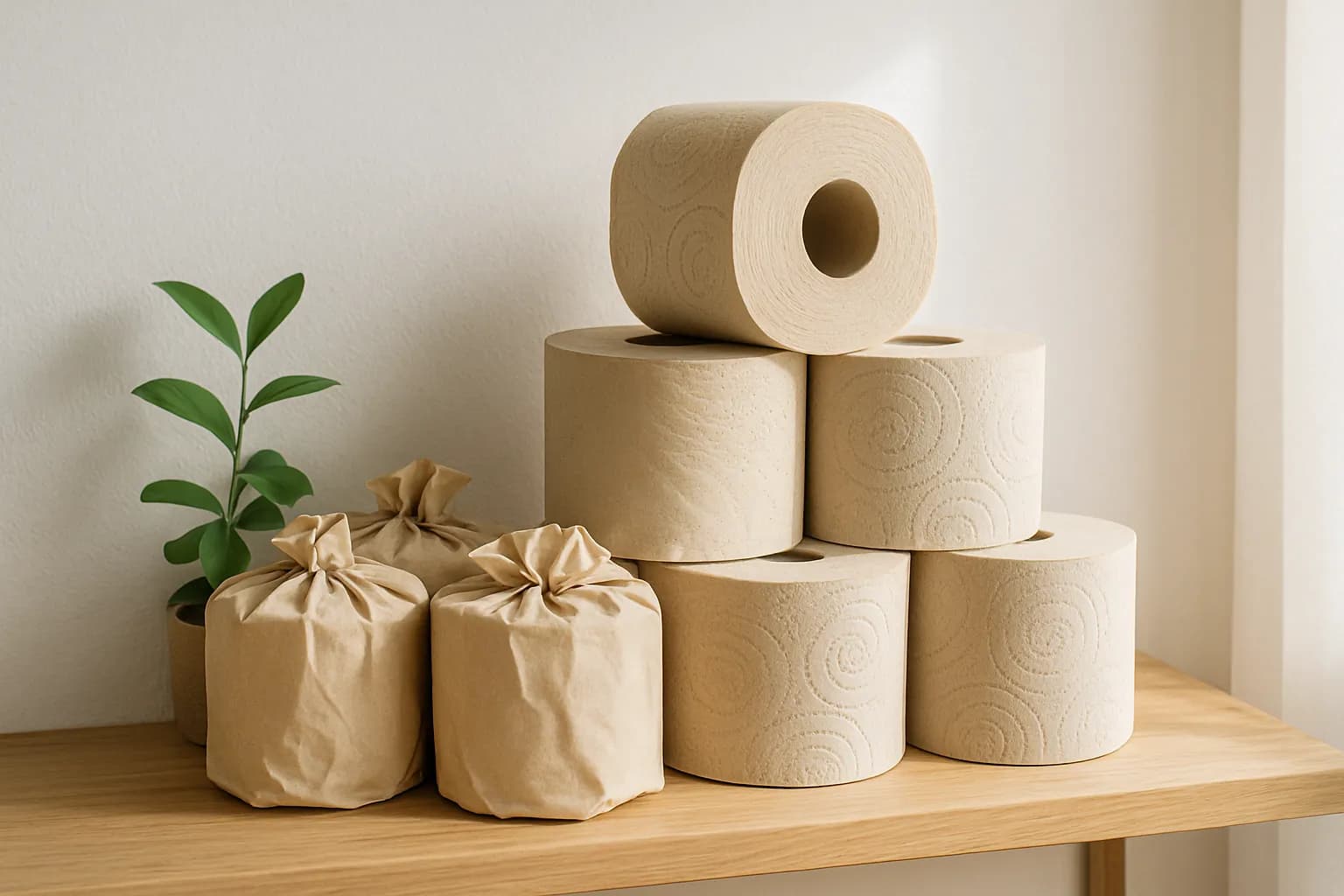
It is the one product almost everyone uses every day and almost nobody thinks about. It appears when you need it, disappears in seconds, and gets replaced without a second thought. But it is worth asking, just once: what is toilet paper actually made of?
The short answer is trees. And once you know how many, and which ones, you may want to look at what is on the shelf a little more carefully.
The quick answer: most conventional toilet paper is made from virgin wood pulp — freshly cut trees — turned into fibre with water and chemicals, then bleached soft and white. Recycled toilet paper is made from recovered paper instead, and tree-free rolls are made from fast-growing plants like bamboo.
What toilet paper is actually made of
Standard toilet paper is mostly virgin wood pulp, made from a blend of two kinds of tree:
- Softwoods like spruce, pine and fir provide long fibres that give the paper its strength.
- Hardwoods like oak, birch and eucalyptus provide short fibres that make it feel soft.
To turn logs into that fluffy roll, the wood is broken down into fibre (usually by the chemical "kraft" pulping process), then bleached to make it white, and pressed and dried into sheets with a lot of water and energy. A single roll of virgin toilet paper takes roughly 1.5 pounds of wood and around 37 gallons of water to make.
That softness, in other words, comes from a mature tree, a chemical bath, and a river's worth of water — for something used once and flushed.
The hidden cost of conventional toilet paper
The scale is genuinely startling. An estimated 27,000 trees a day are cut down worldwide just to make toilet paper — roughly 10 million trees a year — and much of that pulp comes from slow-growing, carbon-rich forests, especially Canada's boreal forest.
That boreal forest is one of the planet's great carbon stores and home to caribou, lynx and billions of migrating birds, as well as Indigenous communities whose way of life depends on it. Environmental groups call the flow of this old forest into two-ply the "tree-to-toilet pipeline," and it is a bigger deal than most of us realise: the United States alone, with about 4% of the world's population, uses roughly 20% of the world's toilet paper, most of it virgin pulp with no recycled content.
Beyond the trees, the process is thirsty and chemical-heavy. Pulping and bleaching use large amounts of water and energy, and older chlorine bleaching created toxic runoff (most mills now use gentler elemental-chlorine-free methods). It is a lot of impact for a product with a lifespan measured in seconds.
A quick word on chemicals
You may have seen alarming headlines about "forever chemicals" in toilet paper. It is worth a calm, honest note: testing has found trace amounts of PFAS or bisphenols (BPA/BPS) in some toilet papers, and — perhaps surprisingly — recycled rolls can carry trace bisphenols picked up from the recycling stream. The levels are generally very low, and this is not a reason to panic. But if you want to minimise it, choose paper that is fragrance-free, dye-free and unbleached (or chlorine-free), and skip the scented, printed and "ultra-plush" novelty rolls, which add the most.
The greener alternatives (ranked honestly)
Here is where a lot of eco guides get one-sided, usually because they are selling one particular roll. The honest picture has three parts, and the biggest win is the one most articles skip.
1. Use less: a bidet
The single most effective change is not a different roll at all — it is a bidet (or a simple bidet attachment for your existing toilet). It cuts toilet-paper use dramatically, often by 75% or more, using a small amount of water that is still far less than the water footprint of the paper it replaces. If you only do one thing, this is it.
2. Recycled toilet paper
For the paper you do still use, recycled toilet paper (ideally 100% post-consumer content) is excellent: it uses no new trees and has the lowest carbon footprint of the three — around 66% lower emissions than virgin. The honest trade-offs are that it can carry those trace bisphenols mentioned above, and older recycled paper felt rougher (modern versions are much softer). Look for "100% post-consumer recycled."
3. Bamboo toilet paper
Bamboo is the other strong tree-free option. Because bamboo is a fast-growing grass, it regrows after cutting without replanting and matures in a few years rather than decades, and bamboo TP produces roughly 30% fewer emissions than virgin wood. The honest caveats: most bamboo is grown and processed in China, so it carries shipping miles, and it still has to be pulped and is often bleached. (Ignore the common "produces 35% more oxygen" marketing line — it is not well supported.)
| Virgin (conventional) | Recycled | Bamboo | |
|---|---|---|---|
| Made from | Freshly cut trees | Recovered paper | Bamboo (a grass) |
| New trees cut | Yes | No | No |
| Emissions vs virgin | Baseline | ~66% lower | ~30% lower |
| The honest catch | Deforestation; the highest impact | May carry trace bisphenols | Usually shipped from China |
So which should you actually buy?
The genuinely green routine is not complicated: add a bidet to cut how much paper you use, then buy either recycled or bamboo for the rest. If lowest emissions are your priority, 100% post-consumer recycled wins; if avoiding trees entirely matters more to you, go bamboo. Either one beats virgin pulp comfortably.
Whichever you choose, a few labels are worth looking for: 100% recycled (post-consumer) or FSC-certified bamboo, unbleached or chlorine-free, fragrance- and dye-free, and plastic-free packaging (many eco brands now wrap rolls in paper). Avoid the scented, dyed, ultra-plush rolls, which combine the highest footprint with the most additives.
The bottom line
So, what is toilet paper made of? Usually a freshly cut tree — often from an ancient, carbon-storing forest — bleached soft and flushed within seconds. It does not have to be. A bidet plus a recycled or bamboo roll gives you the same everyday comfort while keeping forests standing, and it is about the easiest swap in the house to feel good about.
Ecoxee is an Amazon Associate and may earn from qualifying purchases through these links. Learn more.

Amazon Aware Bamboo Toilet Paper (24 rolls, FSC-certified)
Tree-free 3-ply toilet paper made from FSC-certified bamboo, unscented and plastic-free. A genuinely greener roll that skips the virgin wood pulp entirely.
Read our full review →
LastTissue Reusable Cotton Tissues
Soft organic-cotton tissues in a pocket silicone case, cleverly designed to keep clean and used ones separate: a washable stand-in for paper tissues on the go.
Read our full review →For more simple bathroom swaps, browse our zero-waste home guides or the full Ecoxee shop.
Keep reading: Zero-Waste Cleaning Products: A Plastic-Free Kit, Zero-Waste Deodorant: Bars, Jars & Refills, and Zero-Waste Dish Soap: Plastic-Free Ways to Wash Up.